Dental treatment for dogs and cats
Dr Janine Sommer, veterinary surgeon, examines and treats the teeth of dogs and cats under anaesthesia, using dental X-rays, at our practice in Berlin-Westend or at your home. With us, dental treatment costs from €500, and you can reach us on +49 170 2351060, by WhatsApp or via the form. Pets rarely show obvious signs of toothache. You may only notice that your pet chews differently, has bad breath or leaves food in the bowl.
- Costs
- Dental treatment costs from €500. We give you an estimate after the examination.
- Contact
- Use the form, call or send a WhatsApp message.
- Where
- At our practice in Berlin-Westend or at your home.
How to spot dental problems
- Your pet has bad breath.
- Your pet chews on one side, drops food or eats more slowly.
- You can see yellowish-brown deposits on the teeth or red gums.
- Your cat goes to the bowl but does not eat, or grooms less often.
Have your pet’s teeth checked if you notice these signs, even if your pet is still eating. Many dental problems, however, show no signs at all or develop so gradually that you do not notice them. That is why a thorough examination of the mouth makes sense for every pet, and for many a preventive dental X-ray as well, especially for small dogs and all cats.
My dog has bad breath · My cat drops food from their mouth · Tooth resorption in cats
What we do
- Examination of the teeth and gums.
- Dental X-rays. Much of each tooth is below the gum line. Only an X-ray shows whether the root is healthy.
- Dental cleaning: we remove tartar and plaque, including below the gum line, then polish the teeth.
- Treatment for gum inflammation and periodontal disease.
- Tooth extraction when a tooth cannot be saved.
- Treatment for tooth resorption (FORL) in cats. With this condition, the tooth breaks down from within. It is painful and often cannot be seen from the outside.
- Root canal treatment.
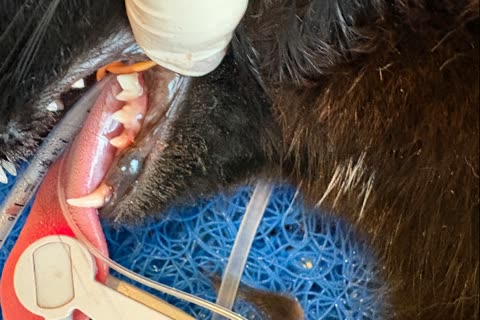
Why dental treatment needs an anaesthetic
Pets cannot hold their mouths open and still for minutes at a time. To clean below the gum line, take X-rays or extract a tooth, we need your pet to be asleep and unable to feel pain. We examine your pet before the anaesthetic and monitor them throughout.
At home or at the practice
Our dental X-ray machine is portable. We can check your pet’s teeth at home and treat them there if conditions are suitable. We carry out more extensive dental treatment at our practice in Berlin-Westend. We use inhalation anaesthesia.
What happens during dental treatment
- Initial check: we look in your pet’s mouth as far as they allow while awake and discuss what we think may be wrong.
- Anaesthesia and X-rays: once your pet is asleep, we X-ray the teeth to see which need treatment.
- Treatment: we clean the teeth and remove any that cannot be saved.
- Recovery and aftercare: we tell you what your pet can eat in the first few days and what to look out for.
What it costs
With us, dental treatment costs from €500.
If teeth need to be extracted, the cost can be considerably higher. Often only the dental X-rays under anaesthesia show how many teeth are affected. Only then can we estimate the cost.
Dental treatment includes several items under the German fee schedule for veterinarians (GOT): anaesthesia, monitoring, dental X-rays, cleaning and extractions. Cleaning and polishing cost €73.74 to €221.23. The other items cost extra. See the full breakdown of fees
Questions and answers
Can you clean my pet’s teeth without anaesthesia?
No. We only treat teeth under anaesthesia. This allows us to clean below the gum line and take X-rays without causing your pet pain or fear.
Is anaesthesia too risky for my older pet?
Age is only one factor. We examine your pet beforehand and explain what we think the risks are.
Can you treat my pet’s teeth at home?
We can examine and X-ray the teeth at home. We discuss with you beforehand whether we can treat them there too.
How can I prevent tartar?
By brushing your pet’s teeth. We can show you how to help your pet get used to it.
My puppy is losing teeth. Is that normal?
Usually, yes